Best remineralizing gum 2026: 14 brands ranked
Fourteen hydroxyapatite gums, ranked on what each brand publishes about its own product, re-checked on the brands' own pages on 23 October 2026. Only two of them print how much hydroxyapatite is in a piece. I make one of the fourteen, so the criteria come first and every cell has a source. Whether the category works at all is a different question, answered in our label-by-label test of remineralizing gum. This page answers which one to buy.
Published September 2026 · Updated October 2026 · Last reviewed: 23 October 2026 · 21 min read
One piece, once a day, with the dose on the page
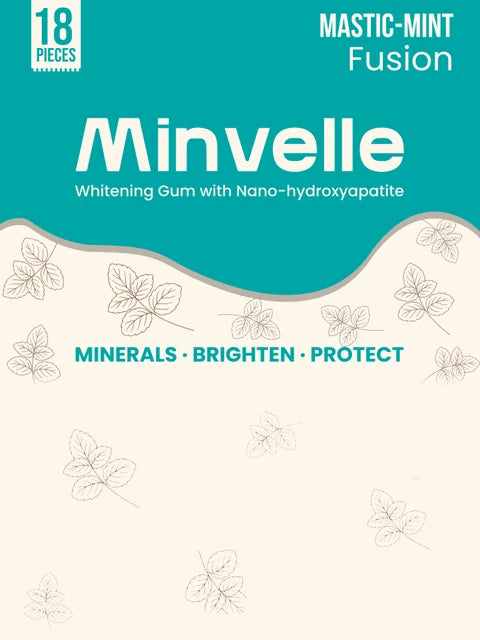
Minvelle is a sugar-free gum with 5.7 mg of nano-hydroxyapatite per piece: one piece a day after a meal, chewed for at least 20 minutes. A box holds 18 pieces, which is 18 days, and it sits alongside your fluoride routine rather than replacing it. The full formula and the batch certificate are published.
Try Minvelle with 10% off orders from €29What is the best remineralizing gum in 2026?
The best remineralizing gum in 2026 is the one that prints its dose: of the 14 gums ranked here, only Minvelle (5.7 mg nano-hydroxyapatite per piece, batch certificate public) and Crait (70 mg non-nano hydroxyapatite per piece) say how much mineral is in a piece. We make Minvelle and rank it first on six published criteria, so every number below links to its source and you can check us. Dentagum is third because it is the only other brand that publishes lab reports. The other eleven state no hydroxyapatite amount at all, and three of them (Underbrush, Kreain, Aurien) cite studies that did not open to the record claimed when we checked. Every brand's numbers, sourced cell by cell, sit in our hydroxyapatite gum database.
Does any of them have proof it works?
No brand on this list, ours included, has a published clinical trial on its own finished gum. The gum-format record for hydroxyapatite is two small studies, a 2014 trial on dentin hypersensitivity and a 2023 in situ study on enamel minerals, and neither measured cavities. So "best" here means best disclosed and best priced for what is shown. It is not a clinical result.
Disclosure: this guide is by Minvelle. We make a remineralizing gum ourselves and hold it to the same six criteria as every other brand on this page.
- 2 of 14 brands publish a hydroxyapatite amount per piece, 2 of 14 publish a lab document you can open, and 3 of 14 cite studies that did not open to the record claimed (our hydroxyapatite gum citation audit).
- The one controlled trial of a hydroxyapatite chewing gum enrolled 107 people, and 100 completed it; it measured dentin hypersensitivity at one and two weeks, not cavities (Porciani, Chazine and Grandini, J Clin Dent 2014, PMID 25122980).
- The EU's authorised claim that "sugar-free chewing gum contributes to the maintenance of tooth mineralization" carries a condition: "the beneficial effect is obtained with chewing, for at least 20 minutes, after eating or drinking" (Commission Regulation (EU) No 432/2012).
- A 2025 narrative review of 15 clinical studies reported hydroxyapatite performing similarly to fluoride for caries prevention, mostly in toothpaste rather than gum, and called for standardized long-term studies (Naim and Sen, J Funct Biomater 2025, PMID 41003396).
| 1 box 18 pieces €24.99 + €3.99 shipping |
Add to cart |
| 2 boxes 36 pieces €39.99 free shipping |
Add to cart |
| 4 boxes 72 pieces €64.99 free shipping |
Add to cart |
| 6 boxes 108 pieces €94.99 best one-time price |
Add to cart |
| Plan 2 boxes every 4 weeks €29.99 free shipping, locked for as long as you stay |
Choose the plan |
Free shipping from €29, 9 to 15 business days from dispatch. 30-day refund on unopened boxes. Published-Number Guarantee: if any number on our label or our transparency page differs from the documents we publish, we refund your last order, opened or not.
Want the unfiltered version first? Read what Reddit says about remineralizing gum, 19 threads with the quotes and the dentist replies. Before you order any of them, run the brand through our nine checks for whether a remineralizing gum is legit.
The quick verdict, in one screen
Here is the ranked order, with the single fact that placed each brand where it is. All of it comes from our brand database, the review pages linked below and the brands' own pages, re-read on 23 October 2026. Where a brand publishes nothing, the row says nothing; we never estimate a dose a company has not stated. If you want the ingredient itself explained first, start with our guide to nano hydroxyapatite gum.
| Best for | Pick | The fact behind it |
|---|---|---|
| A published hydroxyapatite dose per piece | Minvelle (ours) | 5.7 mg nano-hydroxyapatite per piece; full list with amounts, batch certificate and safety data sheet published. Cons: €1.39 a piece from a single box (€0.83 on the plan); chew at least 20 minutes; no clinical trial on our finished gum. |
| A printed dose, non-nano | Crait | 70 mg non-nano hydroxyapatite per piece stated; no lab report published; sorbitol and maltitol ahead of xylitol |
| Lab reports you can open | Dentagum | Heavy-metal and phthalate reports on the product page; about $0.55 a piece; no dose |
| A stated particle size and linked studies | Enamio | 20 nm rods stated, 14 studies linked; no dose |
| A low price per piece | Weldental Micro Hydroxyapatite Gum | About $0.26 a piece (50 for $12.99), xylitol first; no dose, no size number |
Each label rests on what the brand publishes on its own page. It is not a taste or results test.
- Minvelle (ours): 5.7 mg nano-hydroxyapatite per piece, 817 mg xylitol, particle size, safety data sheet and batch certificate all published.
- Crait: 70 mg non-nano hydroxyapatite per piece stated; supplier describes a calcium carbonate core with a hydroxyapatite shell.
- Dentagum: lab reports on the page, nano-hydroxyapatite first and xylitol second; percentages presented as clinical proof without a published gum study.
- Enamio: 20 nm particle size stated and 14 studies linked; no dose.
- CaviChew: particle size of 100 nm or below stated, xylitol first; no dose, no citations.
- Weldental Micro Hydroxyapatite Gum: the cheapest per piece, xylitol first; hydroxyapatite sixth on the list, no dose.
- Halo: xylitol listed first; no dose; bacteria-reduction percentages without a named source.
- Larineco: full sweetener list; no dose, size or concentration; "thousands of peer-reviewed studies" with zero cited.
- Kreain: 18 checkable citations of 39; ten resolved, eight did not; no dose.
- Underbrush: five of eight spot-checked citations misresolve; no dose; no piece count per pack.
- Aurien: homepage cites a "Harvard Health Study" that does not exist under that name; no dose.
- VanMan: cattle-bone hydroxyapatite; no dose, no size, no piece count published.
- ApaCare: description names hydroxyapatite, printed ingredient list names calcium carbonate; no dose.
- Gud Gum+: no ingredient list on its own page; zero citations; no refunds once ordered.
RevitaBite is in our database, but we have not reviewed it in full, so it appears in the table below and is not ranked. Generic xylitol gum, PUR and Trident White make no hydroxyapatite claim, so they are not scored here.
Best hydroxyapatite gum: how to compare options
Best hydroxyapatite gum, judged on what each brand publishes: of the fourteen gums ranked here, only Minvelle states a nano-hydroxyapatite dose per piece, 5.7 mg, in a box of 18 at €24.99. Crait states 70 mg of non-nano hydroxyapatite per piece. The other twelve state no per-piece amount at all. We make Minvelle, so read the source column and check us.
This is not a taste test and not a lab test. We did not send gums to a laboratory, and chewing fourteen brands for a week each would tell nobody anything about enamel. What we did is slower and more boring: we read every brand's own product page, ingredient list, FAQ, study section and refund policy, and wrote down what was there and what was not. The ranking is a sort of that record on six criteria a buyer can check without trusting us, in this order of weight.
- A published hydroxyapatite dose per piece, in milligrams. The single number that separates a product from a promise. If it is not on the brand's page, the cell says "not published", and we do not estimate it from ingredient order, pack weight or price.
- A full ingredient list, ideally with amounts. All ingredients named, in order, on the brand's own page, and the form of the mineral: nano or not, and at what size. Amounts per piece score higher than a bare list. A brand whose description and ingredient list disagree gets no credit, because you cannot know which one to believe.
- Batch testing you can open. A certificate of analysis or lab report as a document you can download or read in full. A "third-party tested" badge without the report does not count, and a report on heavy metals is not a report on the mineral content.
- Sugar-free, with the xylitol amount. All fourteen are sugar-free. The question is whether the brand tells you how much xylitol a piece carries, or only where xylitol sits on the list, and whether the sweetener is xylitol at all or a sorbitol and maltitol blend.
- Price per piece. Computed only from the brand's own site on 23 October 2026, and only where both a price and a piece count are published; otherwise the cell says "check site". Price breaks ties inside a tier; it never lifts a brand out of one.
- Availability in the EU and the US. Which currency the shop shows a visitor from the EU, and whether the gum is sold through the brand's own shop or only through a marketplace.
One penalty sits on top. Our citation audit runs a two-part check on every identifier a brand publishes: does the PubMed ID or DOI resolve at all, and does the record it opens match the authors, journal, year and finding the brand attributes to it? A missing citation is a disclosure gap. A citation that opens to a different paper is a different kind of problem, because the reader has been told something that is not so, so we weight it more heavily.
Two more things went into the sort without being scored. Where a brand states a money-back guarantee, we checked whether the product page and the refund policy say the same thing. And where a brand shows a review count, we checked whether it lives on a third-party platform you can open or in an on-site widget you cannot. Neither moved a brand more than one place.
Every fact carries a date. If a brand publishes a dose, a size or a lab report after 23 October 2026, its place here is out of date, and I would like to hear about it so we can move it. The full record, including rows for brands we have not ranked, lives in the hydroxyapatite gum database, free to reuse under CC BY 4.0.
Two new flavours land in December
Calm Matcha and Warm Cinnamon. Join the first-dibs list and pick yours before anyone else.
Fourteen remineralizing gums, side by side
"Not published" means the brand's own page does not state the figure, not that the figure is zero. Prices were read on the brands' own sites on 23 October 2026 from Austria; some shops convert to euros for EU visitors, so each price keeps the currency the shop showed us. Where a shop publishes no piece count, the cell says "check site".
| # | Brand | HAp per piece | Ingredient list | Lab documents | Xylitol | Price per piece | Currency / channel |
|---|---|---|---|---|---|---|---|
| 1 | Minvelle (ours) | 5.7 mg nano, 0.30% of a 1.9 g piece | All 14, with amounts | Batch certificate + safety data sheet, downloadable | 817 mg per piece (43%), first ingredient | €0.83 (plan) to €1.39 (1 box) | EUR; ships to 35 countries incl. the US |
| 2 | Crait | 70 mg non-nano (stated) | 9 ingredients, no amounts; sorbitol and maltitol come before xylitol | "Third party tested" stated; no report published | 4th on the list, amount not published | Check site ($24.99; pack options link out) | USD; Amazon |
| 3 | Dentagum | Not published | 12 ingredients, no amounts | Heavy-metal and phthalate reports on the product page; HAp amount not assayed | 2nd on the list, amount not published | about $0.55 ($33.00 for 60) | USD |
| 4 | Enamio | Not published; 20 nm rods stated | Named, no amounts | "3rd-party tested" badge; no report | Named, amount not published | $0.48 to $0.69 (brand's own per-piece labels) | USD |
| 5 | CaviChew | Not published; 100 nm or below stated | On the listing, no amounts | None found | 1st on the list, amount not published | Check listing (marketplace only) | Amazon |
| 6 | Weldental Micro HAp Gum | Not published; "micro", no size | 11 ingredients, no amounts; HAp 6th | None published | 1st on the list, amount not published | about $0.26 ($12.99 for 50) | USD |
| 7 | Halo | Not published | 10 ingredients, no amounts | None published | 1st on the list, amount not published | $0.50 to $0.67 (brand's own labels) | EUR shown to EU visitors |
| 8 | Larineco | Not published | Named, no amounts | Not found | Named, amount not published | about €0.53 (€18.95 for 36) | EUR shown to EU visitors |
| 9 | Kreain | Not published | 15 ingredients, no amounts | No certificate found | 1st on the list, amount not published | Check site (18 pieces a box) | EUR shown to EU visitors |
| 10 | Underbrush | Not published | Full list, no amounts | None published | 1st on the list, amount not published | Check site (pieces per pack not stated) | EUR shown to EU visitors |
| 11 | Aurien | Not published | 12 ingredients, no amounts | No certificate found | Named, amount not published | Check site | EUR shown to EU visitors |
| 12 | VanMan | Not published; cattle-bone HAp | 6 ingredients, no amounts | None published | Named, amount not published | Check site (no piece count) | EUR shown to EU visitors |
| 13 | ApaCare | Not published; the printed list names calcium carbonate | 9 ingredients; only xylitol has an amount | No certificate; ISO 13485 named in the imprint | 56%, the only xylitol figure besides ours | Check site | EUR (Amazon.de) |
| 14 | Gud Gum+ | Not published ("vegan hydroxyapatite") | None on its own page | ISO 22000 badge; no report | Named in the description | about ₹13 (₹200 for 15) | INR; India |
| n/r | RevitaBite | Not published | No amounts; liquid centre called "proprietary" | None published | In the liquid centre, amount not published | Check site | USD |
Data: each brand's own page, read 23 October 2026, plus the dated cells of our hydroxyapatite gum database. n/r = listed, not ranked (not yet reviewed). Prices drift; check the shop before you buy.
The 14 remineralizing gums, one by one
1. Minvelle (ours)
I will be plain about this one: I make it, and it is first because the criteria above put it first, not because it is mine. If you think that is convenient, you are right to, and the fairness section further down tells you how to check us with the same tools we used on everyone else.
What is published on our transparency page: each piece of Minvelle gum contains 5.7 mg of nano-hydroxyapatite, which is 0.30 percent of a 1.9 g piece and about 103 mg per box of 18. Xylitol is the first ingredient at 817 mg per piece (43 percent), erythritol second at 285 mg (15 percent), and the gum base is chicle and mastic with a touch of spruce. All 14 ingredients are listed with their role. The particle form is rod-shaped, 200 nm long and 20 to 50 nm wide, as stated by our supplier; the width sits inside the EU's 1 to 100 nm nanomaterial definition, and we corrected the wording on that point on 22 August 2026 after an earlier version was less precise. Every batch is lab-tested: the batch certificate (heavy metals and microbiology) and the safety data sheet are downloadable as PDFs with the manufacturer's name redacted, which the page says openly. The dose is printed on the box.
What is not there, and I want it in the same paragraph: there is no clinical trial on the finished Minvelle gum. None. The two gum-format hydroxyapatite studies that exist did not use our product. On price we are not the cheapest: €1.39 a piece from a single box, €0.88 from 6 boxes, €0.83 on the plan of 2 boxes every 4 weeks for €29.99. We ship to 35 countries, the EU and the US included, in 9 to 15 business days from dispatch, free from €29. Unopened boxes carry a 30-day refund. Our Trustpilot profile is claimed and still small; the current score is on the profile itself.
Why first: it is the only brand of the fourteen that publishes a dose per piece, a full ingredient list with amounts, a batch certificate and its xylitol figure. That is the whole case. Take the dose off the page and we would sit somewhere around Dentagum and Enamio.
2. Crait
Crait is the only other brand in the fourteen that states a per-piece amount, and that alone puts it second. Its own page, read on 23 October 2026, says each piece delivers "70 mg of non-nano hydroxyapatite". Our Crait review of 2026 adds the catch: the ingredient's supplier describes it as a calcium carbonate core with a hydroxyapatite shell, and neither company publishes the hydroxyapatite share of that particle. So the 70 mg is a real, printed number, but not quite the number the front of the pack is trading on.
The composite is non-nano, which makes Crait the one ranked gum that does not lean on the word nano at all. The ingredient list has nine entries and no amounts, and it runs gum base, sorbitol, maltitol, xylitol, isomalt, then hydroxyapatite: a polyol blend with xylitol in fourth place. The page says "third party tested" without publishing the report, and our review found no studies cited. The brand page shows one price, $24.99, while its 30, 60 and 180 count options link out to Amazon, so we could not compute a per-piece price on Crait's own site.
Why second: a printed number, even a composite one, is more than twelve brands below it offer. Why not first: there are no documents behind the number, no xylitol amount, and the hydroxyapatite fraction that matters is not published.
3. Dentagum
Dentagum sells a sugar-free "Remineralizing Chewing Gum with Nano-Hydroxyapatite & Xylitol": nano-hydroxyapatite is the first of its 12 ingredients, xylitol the second, and eggshell powder the ninth, which its own blog calls "a supporting ingredient, not the primary remineralizing active." Our Dentagum review goes through each claim. A pouch of 60 pieces costs $33.00, about $0.55 a piece (re-checked 23 October 2026). An earlier version of this entry said Dentagum leads its marketing with eggshell calcium; its product page leads with nano-hydroxyapatite, so we corrected it.
Dentagum moves up from sixth in our September version, and the reason is criterion three. Its product page carries lab reports you can read, a heavy-metal panel and a phthalate test from Light Labs, dated June and July 2026 in our database entry of 4 October. Those reports do not measure the hydroxyapatite content, so they show the gum is clean on those panels, not how much mineral is in it. Dentagum's citations open, but its blog says of eggshell that "Current evidence is in vitro", and its nano-hydroxyapatite sources tested toothpaste. The clinical-sounding figures on its product page (83, 91, 87 and 79 percent) come with no published study on the gum.
Why third: lab reports you can open, citations that exist, a fair price. Why not higher: no dose, and percentages without a study behind them.
4. Enamio
Enamio leads the group of brands that publish something specific about their mineral without publishing how much of it is in a piece. Its page states a 20 nanometre rod-shaped particle, which our Enamio comparison summarises this way: it "publishes a 20 nanometre particle size... it publishes no dose per piece." Twenty nanometres is well inside the EU nanomaterial range, so the nano label is at least consistent with the number given.
On evidence, Enamio links 14 studies, the largest cited set of any brand here, and our citation audit graded them on their own merits. Its FAQ carries percentages that are not tied to a specific citation, and its "3rd-party tested" badge has no report behind it that we could find. Xylitol is named, without an amount. The shop prints its own per-piece prices: $0.69 for 2 packs (36 pieces), $0.55 for 4 packs, $0.48 for 8 packs, which puts it in the middle of the field.
Why fourth: a real particle size, a large linked bibliography, a fair price. Why not higher: no dose, and no lab document behind the size.
5. CaviChew
CaviChew states a particle size of 100 nm or below and lists xylitol first. Our CaviChew review records "a published particle size (100 nm or below)... and no dose per piece anywhere on the listing." It sells through a marketplace listing rather than its own shop, so the price moves with the listing; in September it worked out to about €0.43 a piece, and today the honest cell is "check the listing".
The gap is evidence. Our review found no citations at all on the listing we checked: no study named, no link, no identifier. That is a disclosure gap rather than a misrepresentation, which is why CaviChew sits above every brand whose citations failed our audit, and below Enamio, which at least shows its reading list. Why fifth: size published, xylitol first, restrained claims. Why not higher: no dose, nothing cited, and no shop of its own to check a price on.
6. Weldental Micro Hydroxyapatite Gum
A correction first. Our September version ranked Weldental last as "not a gum", because our Weldental review covered its ChewTabs, a nano-hydroxyapatite toothpaste tablet you chew for a few seconds and then brush off. Weldental also sells a real chewing gum, Micro Hydroxyapatite Gum with Xylitol, on its own shop. That gum is the product ranked here; the tablet belongs in a toothpaste comparison and stays out.
The gum lists 11 ingredients: xylitol first, then gum base, maltitol, flavouring and maltodextrin, with hydroxyapatite sixth and calcium carbonate after it. A bottle of 50 pieces at 2.4 g each costs $12.99, about $0.26 a piece, the lowest price of any gum ranked here by a wide margin. The particle claim is "majority of micro hydroxyapatite particles are smaller than dentin tubules", with no number. There is no dose, no lab report and no study cited.
Why sixth: an honest, cheap, xylitol-first gum with a complete list. Why not higher: nothing about the mineral is quantified, and it sits low on the list.
7. Halo
Halo Advanced Gum lists xylitol first on a 10-ingredient panel, with nano-hydroxyapatite third, which is one of the clearest ingredient disclosures in this tier, and its shop prints per-piece prices of $0.50 to $0.67 depending on pack size. Our Halo review found "no milligram amount or particle size for its nano-hydroxyapatite anywhere we could find."
Where Halo drops below the brands above is the numbers it does publish. Its page states bacteria-reduction figures of 48 percent and 99 percent, footnoted to an unnamed human trial, and our review could not find the study. A precise percentage with no study behind it is worse, in our scoring, than no percentage at all, because a reader will remember the number and not the absence of a footnote. Why seventh: good ingredient transparency, fair price. Why not higher: no dose, no size, and percentages without a citation.
8. Larineco
Larineco publishes a fuller ingredient list than most: nano-hydroxyapatite, xylitol, erythritol, chicle, mastic, eggshell powder and bentonite are all named. What it does not publish is any quantity. Our Larineco review found that the brand "states no dose, particle size or concentration, and the company's own terms of service describe the products as cosmetic oral care items."
The evidence line on Larineco's page reads "Backed by thousands of peer-reviewed studies", and our review found zero of them cited. That is a claim of volume with no specimen, and it costs Larineco a place above the brands that at least name real studies. The eggshell powder and bentonite are worth knowing about if you have an egg allergy or simply want to know what you are chewing. An order is two packs of 18, 36 pieces, which the shop showed us at €18.95, about €0.53 a piece. Why eighth: full ingredient naming, a low price. Why not higher: no quantities of anything, and an evidence claim with nothing behind it.
9. Kreain
Kreain opens the tier where citations failed our audit. Its page carries 39 references. Our Kreain review reports: "Of the 39, 18 carry a checkable identifier... Ten checked out. Eight did not." Eight of eighteen is a 44 percent failure rate among the citations that could be checked at all; the other 21 had no identifier to check.
One detail from the audit deserves its own sentence: three of Kreain's citation errors are identical to errors on Underbrush's page. We do not know why, and we do not guess. It is recorded because two brands sharing the same wrong references is a fact a buyer might want. The list of 15 ingredients runs xylitol first, a box holds 18 pieces, and the product page promises a 60-day money-back guarantee while the refund policy allows 30 days, unused. No dose, no particle size, no certificate. Why ninth: ten citations that resolved correctly is more than most brands manage. Why not higher: eight that did not.
10. Underbrush (Nathan & Sons)
Underbrush is probably the most-searched nano-hydroxyapatite gum in the English-speaking market, and it publishes a complete ingredient list with xylitol first. Our Underbrush review notes that across the customer discussion we read there was "not one thread asking the dose per piece, which the brand does not publish." No particle size is stated either, and the page does not say how many pieces a pack holds, only that a four-pack lasts about 30 days at two pieces a day, so we do not compute a per-piece price.
The citation spot-check is what puts Underbrush below Kreain. Of eight references we checked, five did not resolve to the record the page attributes to them. Our audit uses the same language for every brand: "wrong record", "wrong authors", "malformed link". Five of eight is the highest failure share of any spot-check in our database. Why tenth: a well-known, widely available gum with a complete ingredient list. Why not higher: no dose, no size, no piece count, and the highest citation-failure share we have measured.
11. Aurien
Aurien states nano-hydroxyapatite with no size and no dose, and its evidence section has one feature no other brand here shares. Our Aurien review puts it directly: the homepage cites a "Harvard Health Study", and "'Harvard Health Study' is not the name of a study; it is not the name of anything." We could not find a paper, a press release or a page under that title.
To be fair to Aurien, the review also found three real citations on its page. None of the three is about gum, and all three are shown as screenshots rather than links. The homepage advertises a 60-day money-back guarantee; the refund policy states 30 days and excludes personal-care goods. No piece count was published where we looked. Why eleventh: three real references exist. Why not higher: the most prominent one on the site does not.
12. VanMan
VanMan is the one brand in the ranking whose hydroxyapatite is stated to come from cattle bone rather than a synthetic process, in a six-ingredient list with chicle, mastic and organic xylitol. Beyond that, our VanMan review found "the boldest remineralization verbs we have reviewed, and no particle size, no dose and not even a piece count published."
The missing piece count is why the price column reads "check site": without it, there is no honest way to divide the pack price. No studies were cited on the page we reviewed. The bovine source is a legitimate choice, but it is also a reason to want a certificate of analysis, and there is none published. Why twelfth: the source of the mineral is at least named. Why not higher: nothing about it is quantified, down to how many pieces you are buying.
13. ApaCare
ApaCare is the brand whose two descriptions of itself disagree. The product description names "tooth enamel minerals (hydroxyapatite)". The printed ingredient list, per our ApaCare comparison, has "no hydroxyapatite named in it and no per-piece dose," and names calcium carbonate instead. Xylitol is stated at 56 percent, the only xylitol figure in the field besides ours.
ApaCare links 11 studies, none of them on a gum, and publishes no certificate of analysis; its imprint names an ISO 13485 certification. It sells mainly in the German-speaking market and on Amazon.de. Why thirteenth: strong xylitol disclosure. Why not higher: when the ingredient list and the marketing name different minerals, the ingredient list wins, and it does not say hydroxyapatite.
14. Gud Gum+
Gud Gum+ sells a "Dental Remineralising Chewing Gum with HAP" from India at ₹200 for 15 pieces, about ₹13 a piece. It describes its active as "vegan hydroxyapatite" and its URL contains "nhap", but our Gud Gum+ review could not find an ingredient list on the brand's own page at all. Without one, there is no way to say whether the mineral is nano or what else is in the piece.
On evidence, the review is blunt: "There is no study cited, not for this product, not for this dose, not for hydroxyapatite in gum at all." The refund policy allows no cancellation or refund once an order is placed. Why fourteenth: it is, as far as we can tell, a gum with hydroxyapatite in it. Why not higher: as far as we can tell is all we can say.
Who each tier is for, honestly
Fourteen positions make a neat list and a poor buying guide. The list really splits into four groups, and the group matters more than the rank inside it.
Tier 1, a dose is printed (Minvelle, Crait). For the buyer who wants to know what is in the piece before spending money on it. Pick Minvelle for nano-hydroxyapatite with a batch certificate and the xylitol amount; pick Crait if you specifically want non-nano. If you only want a sugar-free gum to chew after lunch, you are overpaying in this tier and should look lower.
Tier 2, something real is published, but not the dose (Dentagum, Enamio, CaviChew, Weldental, Halo). For the buyer who wants a hydroxyapatite gum at a mid-market or low price and accepts a size, a lab panel or a sweetener order instead of an amount. Weldental is the value pick on price alone, Dentagum the pick for lab reports, Enamio the pick if you want to read the brand's sources yourself. Halo is a fine sugar-free gum with claims that outrun its footnotes.
Tier 3, the claims outrun the page (Larineco, Kreain, Underbrush, Aurien). This is the tier I would think hardest about. The gums themselves may be perfectly good sugar-free gums; the problem is that their pages told us things about the science that the science did not say when we looked it up. If you buy here, buy for the chewing and ignore the study section.
Tier 4, the product is not fully described (VanMan, ApaCare, Gud Gum+). For nobody in particular until the pages change. VanMan does not tell you how many pieces you get. ApaCare's ingredient list does not name the mineral its description advertises. Gud Gum+ has no ingredient list we could find.
And the rows we did not score: plain xylitol gum, PUR and Trident White. If you want the saliva benefit and nothing else, any genuinely sugar-free gum from a supermarket does that job at a fraction of every price on this page, and our label test explains why. They are not worse remineralizing gums; they do not claim to be remineralizing gums at all. For the everyday gums dentists point to, see our guide to the best gum for teeth, and for gentler picks, our six gentle gum picks.
How to read a gum label in two minutes
You do not need our ranking to judge a gum you find somewhere else. These six checks are the ones we ran, in the order that saves the most time. They are the short form of our field guide to testing a remineralizing gum yourself.
- Find the milligrams. Look for "mg per piece" next to hydroxyapatite. A percentage of the gum is weaker, and "strongest dose" is not a number. No figure means you cannot compare it.
- Read the list, not the front. Ingredients run by weight. Is hydroxyapatite on the list at all, and where? Does the list name the same mineral as the marketing?
- Check the sweeteners. Sugar-free is the baseline. Xylitol first is a good sign; a list led by sorbitol or maltitol is a polyol blend. Only two brands here say how much xylitol a piece carries.
- Ask for the document. A certificate of analysis or lab report you can open beats any badge. Note what it measured: heavy metals and microbes are not the same as the mineral content.
- Open one citation. Pick the study the brand leans on hardest and paste its PubMed number. If it opens a different paper, or tested toothpaste rather than gum, you have learned something.
- Divide the price. Price over pieces, from the brand's own shop. If the piece count is missing, that tells you how transparent the brand is.
For the particle question, nano or not, our nano vs non-nano comparison goes through sizes and the EU definition, and the 16-label remineralizing gum test shows the same checks applied to xylitol and CPP-ACP gums.
Who should skip remineralizing gum
Young children. The choking risk comes from the gum itself, not the mineral, and most gum labels are written for older children and adults. Ask your child's dentist first; our page on whether kids can chew gum covers ages and amounts.
People sensitive to polyols. Xylitol, erythritol, maltitol and sorbitol are only partly absorbed and can cause gas, bloating or loose stools in larger amounts. EU law requires foods with more than 10 percent added polyols to state that excessive consumption may produce laxative effects (Regulation (EU) No 1169/2011, Annex III). Start with one piece a day.
Anyone allergic to an ingredient. Read the allergen line before the first piece. Minvelle contains egg; some brands use eggshell powder, bentonite or bovine-derived hydroxyapatite.
People with jaw problems, fresh dental work or braces. Long chewing can tire a sore jaw, and a sticky gum base can pull at a new filling or bracket. Ask your dentist.
Dog owners, take note. Xylitol is dangerous for dogs. Keep any xylitol gum out of their reach.
What "best" cannot mean on this page
Every ranking on this topic, including this one, is built on a foundation the reader deserves to see. The evidence that hydroxyapatite in a chewing gum does anything to enamel is, as of October 2026, two studies. Here is the short form so the word "best" stays the right size.
The first is Porciani, Chazine and Grandini, published in the Journal of Clinical Dentistry in 2014 (PMID 25122980). It was a double-blind, placebo-controlled trial of a calcium hydroxyapatite gum against an identical gum without it, 107 people enrolled and 100 completing, two pieces three times a day, with dentin hypersensitivity measured at one and two weeks. It found a reduction compared with the placebo gum. It did not measure cavities, enamel hardness or mineral content, and it did not test any brand on this page.
The second is Hassani and colleagues, in the Journal of the Mechanical Behavior of Biomedical Materials, December 2023 (PMID 37852085). A single-blind in situ study with three arms: a mastic-type gum carrying 10 percent plant-synthesised nano-hydroxyapatite by weight, the same gum with 10 percent commercial synthetic nano-hydroxyapatite, and the plain gum. Enamel calcium was highest in the commercial synthetic arm, the plant-synthesised version did less, and phosphorus did not differ. Ten percent is far above any retail gum that publishes a figure, ours included at 0.30 percent. Again, no cavity endpoint, and again, no brand from this list.
The broader claim that hydroxyapatite matches fluoride comes from a 2025 narrative review by Naim and Sen in the Journal of Functional Biomaterials (PMID 41003396), which looked at 15 clinical studies from the prior five years and reported similar efficacy to fluoride for caries prevention. It is a narrative review, the studies it summarises are mostly toothpaste rather than gum, and the authors themselves call for standardized long-term studies. So no gum on this page is a fluoride replacement, and no ranking can make one so.
Xylitol does not rescue the case either. The Cochrane review by Riley and colleagues in 2015 (PMID 25809586) included no chewing-gum trials at all; its clearest signal, rated low quality, came from a fluoride toothpaste with xylitol.
What a sugar-free gum can do is well established and belongs to all of them equally. The EU authorises a claim, under Commission Regulation (EU) No 432/2012, that sugar-free chewing gum contributes to the maintenance of tooth mineralization, when chewed for at least 20 minutes after eating or drinking. That is a saliva effect. A 2014 in situ study by Tuncer, Onen and Yazici (PMC4241604) tested xylitol, sorbitol and xylitol-sorbitol gums across 21-day periods and found no significant change in the enamel calcium-to-phosphorus ratio for any of them, while surface microhardness rose, the paraffin control included. The chewing did the work.
So "best" on this page means: the brand that shows you the most, misstates the least and charges a price you can compute. It does not mean proven to remineralize better than the one below it, because no study on earth has made that comparison for any two of these fourteen gums.
We sell one of these, so check us the same way
Minvelle is my company. It makes one product, and that product is first on a list I wrote. There is no version of this page where that is not a conflict of interest, and I would rather name it than have you find it in the footer. Here is how to audit us with exactly the criteria we used on the other thirteen, in order.
Dose. 5.7 mg per piece, 0.30 percent of 1.9 g, on the transparency page and printed on the box. If you find a page of ours that states a different number, one of them is wrong and I want to know. Ingredient list. All 14 with their roles and the two sweetener amounts. Batch testing. The batch certificate and the safety data sheet are downloadable. The manufacturer's name is redacted on those documents, and the page says so; if that redaction bothers you, it should count against us in your own scoring. Xylitol. 817 mg per piece, first on the list. Price. €0.83 to €1.39 a piece, not the cheapest here, and we do not claim the price buys a clinical result. Availability. 35 countries. Evidence. Every study we cite carries a PubMed number in the sources block below. Open them. The 2014 and 2023 gum studies did not use our product, and we say so on every page that mentions them.
Every negative fact about another brand on this page is attributed to a specific review or audit of ours, with the date we looked. We used the same categories for every brand: "not published", "not found", "wrong record", "check site". We did not use verdict words about any company, and if you find one, tell me and it comes out. Brands change their pages, and when they do, the ranking is wrong until we re-check it. The "Last reviewed" date at the top is the date this page was last true to our knowledge.
Two more things you can do: read our 90-day review of our own gum, and read our whitening gum ranking, which uses the same method on a partly different set of brands, and see whether we placed ourselves consistently. If the method only ever favours us, that is worth noticing.
Gums we reviewed but did not rank
RevitaBite is in our database with a liquid centre it calls proprietary, no dose and no lab report. We have not reviewed it in full, so it is listed and not ranked. Scandi Gum names nano-hydroxyapatite first among its callouts; our Scandi Gum review found no dose, no particle size and no lab report on its pages as of 1 September 2026, and a product-page guarantee that differs from its refund policy. It joins the ranking when it joins the database. PUR is a clean xylitol gum that makes no dental mineral claim; our PUR gum review explains why it belongs on a xylitol shelf, not this one.
Buying from outside the EU or the US? Our where to buy hydroxyapatite gum guide goes country by country.
If the dose is what you were looking for: Minvelle is a sugar-free gum with 5.7 mg of nano-hydroxyapatite per piece, 18 pieces per box, one piece a day, with the full ingredient list and batch certificate published. Try it with 10% off orders from €29, or read the full formula first. Unopened boxes carry a 30-day refund.
Questions people ask before buying
What is the best remineralizing gum in 2026?
On the six published criteria used here, Minvelle ranks first: it is the only gum of the 14 that publishes a hydroxyapatite dose per piece (5.7 mg nano-hydroxyapatite), a full ingredient list with amounts, a downloadable batch certificate and its xylitol amount (817 mg per piece). We make Minvelle, so weigh that and check the sources. Crait is second because it states 70 mg of non-nano hydroxyapatite per piece. Dentagum is third because it publishes lab reports. No brand, ours included, has a clinical trial on its finished gum.
What is the best hydroxyapatite gum?
The same answer, because every gum in this ranking is a hydroxyapatite gum. If you want nano-hydroxyapatite with a stated dose, Minvelle is the only one that publishes it (5.7 mg per 1.9 g piece). If you prefer non-nano, Crait states 70 mg per piece. Every other hydroxyapatite gum we track states no amount, so you cannot compare it on dose at all.
Which remineralizing gums publish a dose per piece?
Two of the 14 ranked brands, checked on their own pages on 23 October 2026. Minvelle publishes 5.7 mg of nano-hydroxyapatite per piece, 0.30 percent of a 1.9 g piece. Crait states 70 mg of non-nano hydroxyapatite per piece; its supplier describes the ingredient as a calcium carbonate core with a hydroxyapatite shell. The other twelve state no per-piece amount.
How much hydroxyapatite should a gum have per piece?
Nobody has established a dose for gum. The 2023 in situ study used experimental gums with 10 percent nano-hydroxyapatite by weight, far more than any retail gum that publishes a figure, ours included at 0.30 percent. The 2014 trial chewed two pieces three times a day. Neither tested a gum you can buy. What a buyer can do is compare published amounts, and only two brands give you one.
Is nano-hydroxyapatite gum better than non-nano gum?
No gum trial compares the two, so nobody can say from evidence. A milligram of nano-hydroxyapatite has far more particles and surface area than a milligram of non-nano, so the mg figures of Minvelle and Crait are not directly comparable. What you can check is whether a nano label comes with a size: Enamio states 20 nm, CaviChew 100 nm or below, Minvelle rods of 200 by 20 to 50 nm.
Does the most expensive remineralizing gum work best?
Price and disclosure do not line up. On the brands' own sites on 23 October 2026, Weldental's gum works out to about $0.26 a piece and Minvelle to €0.83 to €1.39, and neither price tells you anything about results. Pay for the numbers a brand shows you: a dose, an ingredient list with amounts and a lab document you can open.
Can a remineralizing gum replace fluoride toothpaste?
No. The gum-format evidence for hydroxyapatite is two small studies, and neither measured cavities. The 2025 narrative review that reports hydroxyapatite performing similarly to fluoride draws mostly on toothpaste trials. Any gum on this list is an addition to brushing with fluoride toothpaste, not a substitute.
Why is your own gum ranked first?
Because it is the only gum of the 14 that meets the first four criteria at once: published dose per piece, full ingredient list with amounts, a downloadable batch certificate and the xylitol amount. We sell it, so check us the same way: the transparency page carries the dose, the batch certificate and the safety data sheet, and every study on this page carries a PubMed number.
Is a plain xylitol gum a remineralizing gum?
In the EU, any sugar-free gum chewed for at least 20 minutes after eating or drinking may carry the authorised claim that it contributes to the maintenance of tooth mineralization, so in that legal sense yes. That effect comes from saliva. A 2014 in situ study of xylitol and sorbitol gums found no change in the enamel calcium-to-phosphorus ratio after 21-day periods. If saliva is all you want, a cheap sugar-free gum does that job.
Who should not chew remineralizing gum?
Young children, because gum is a choking risk whatever is in it. People who react to polyols such as xylitol, maltitol or sorbitol, because large amounts can have a laxative effect. Anyone allergic to an ingredient on the list (Minvelle contains egg). People with jaw problems, fresh dental work or braces should ask their dentist first. Keep xylitol gum away from dogs.
Hydroxyapatite: The calcium phosphate mineral that makes up most of tooth enamel. In gum it is added as a synthetic powder, or in one case here from cattle bone.
Nano-hydroxyapatite: Hydroxyapatite in particles that meet the EU nanomaterial definition of 1 to 100 nanometres in at least one dimension. Many brands use the word without stating a size.
Dose per piece: The milligram amount of the mineral in one piece. Only two brands on this page publish one.
Certificate of analysis (CoA): A batch-level lab document listing what was measured in one production run. It ties stated numbers to a product that actually shipped.
Polyols: Sugar alcohols such as xylitol, erythritol, maltitol and sorbitol, used to make gum sugar-free. Large amounts can have a laxative effect.
Citation that resolves: A reference whose PubMed ID or DOI opens to a real record whose authors, journal, year and finding match what the brand said. One that opens a different paper is recorded as a wrong record.
In situ study: Enamel samples worn in the mouth on an appliance, then measured in a lab. Closer to real life than a test tube, further from it than a trial on people's own teeth.
Medical disclaimer: this article is educational and is no medical advice. It does not diagnose, treat or replace professional care. Talk to your dentist before changing your oral-care routine. If you have tooth decay, a cracked tooth or tooth pain, see a dentist, because no gum can treat those.
- Porciani PF, Chazine M, Grandini S. J Clin Dent 2014;25(2):32-36 (PMID 25122980): double-blind trial of a calcium hydroxyapatite chewing gum vs placebo gum, 107 enrolled, 100 completed, two pieces three times a day; outcome dentin hypersensitivity at one and two weeks; no caries endpoint.
- Hassani AR et al. J Mech Behav Biomed Mater 2023;148:106155 (PMID 37852085, doi 10.1016/j.jmbbm.2023.106155): single-blind in situ study of mastic-type gums with 10% wt plant-synthesised or commercial synthetic nano-hydroxyapatite vs plain gum; enamel calcium highest in the commercial synthetic arm, phosphorus unchanged.
- Naim J, Sen S. J Funct Biomater 2025 (PMID 41003396, doi 10.3390/jfb16090325): narrative review of recent clinical evidence on hydroxyapatite, mostly toothpaste; calls for standardized long-term studies.
- Riley P et al. Cochrane Database Syst Rev 2015 (PMID 25809586, doi 10.1002/14651858.CD010743.pub2): xylitol-containing products for preventing dental caries; evidence low to very low quality.
- Tuncer D, Onen A, Yazici AR. Dent Res J (Isfahan) 2014 (PMC4241604, PMID 25426142): in situ study of xylitol, sorbitol and xylitol-sorbitol gums over 21-day periods; no significant change in enamel Ca/P ratio.
- Commission Regulation (EU) No 432/2012, Annex: sugar-free chewing gum contributes to the maintenance of tooth mineralization, with the condition of chewing for at least 20 minutes after eating or drinking.
- Regulation (EU) No 1169/2011, Annex III: foods with more than 10% added polyols must state that excessive consumption may produce laxative effects.
- Minvelle transparency page: 5.7 mg nano-hydroxyapatite per 1.9 g piece, 817 mg xylitol, all 14 ingredients, batch certificate and safety data sheet as downloadable PDFs.
- Minvelle, The Hydroxyapatite Gum Database, 2026 edition: every tracked brand's published dose, documents and sources, dated cell by cell, CC BY 4.0.
- Minvelle, The hydroxyapatite gum citation audit, 2026: the resolve-and-match check applied to every brand's published references.
About the author
Max, Founder of Minvelle, builds an Austrian oral-care brand around one rule: publish the numbers, cite the sources, and say plainly what a product cannot do. He is not a dentist, which is why every article on this blog ends by pointing you to yours. The full formula behind Minvelle is public on the transparency page.
Buy the number, not the adjective. Fourteen gums say remineralizing on the front. Two tell you how much hydroxyapatite is in a piece, two publish a lab document you can open, and three cite studies that did not open to what they claimed. Whichever gum you choose, chew it after eating for the saliva, keep brushing with fluoride, and hold every brand on this page, ours first, to the standard of showing its work. Last reviewed: 23 October 2026.
One piece, once a day, with the dose on the page
5.7 mg of nano-hydroxyapatite per piece, 18 pieces a box, one piece a day after a meal. The full formula and the batch certificate are published.
Try Minvelle with 10% off orders from €29Or subscribe: 2 boxes every 4 weeks for €29.99, skip or cancel anytime →
30-day refund on unopened boxes