Investigation · Oral care
The number almost no gum brand will tell you
You can learn almost everything about this category from one line of text that is missing on nearly every box.
- The exercise that exposes the whole category
- Why one missing number changes everything
- What the mineral actually does
- Reading three labels side by side
- The questions a skeptic should ask
- Why a 20-year-old built this
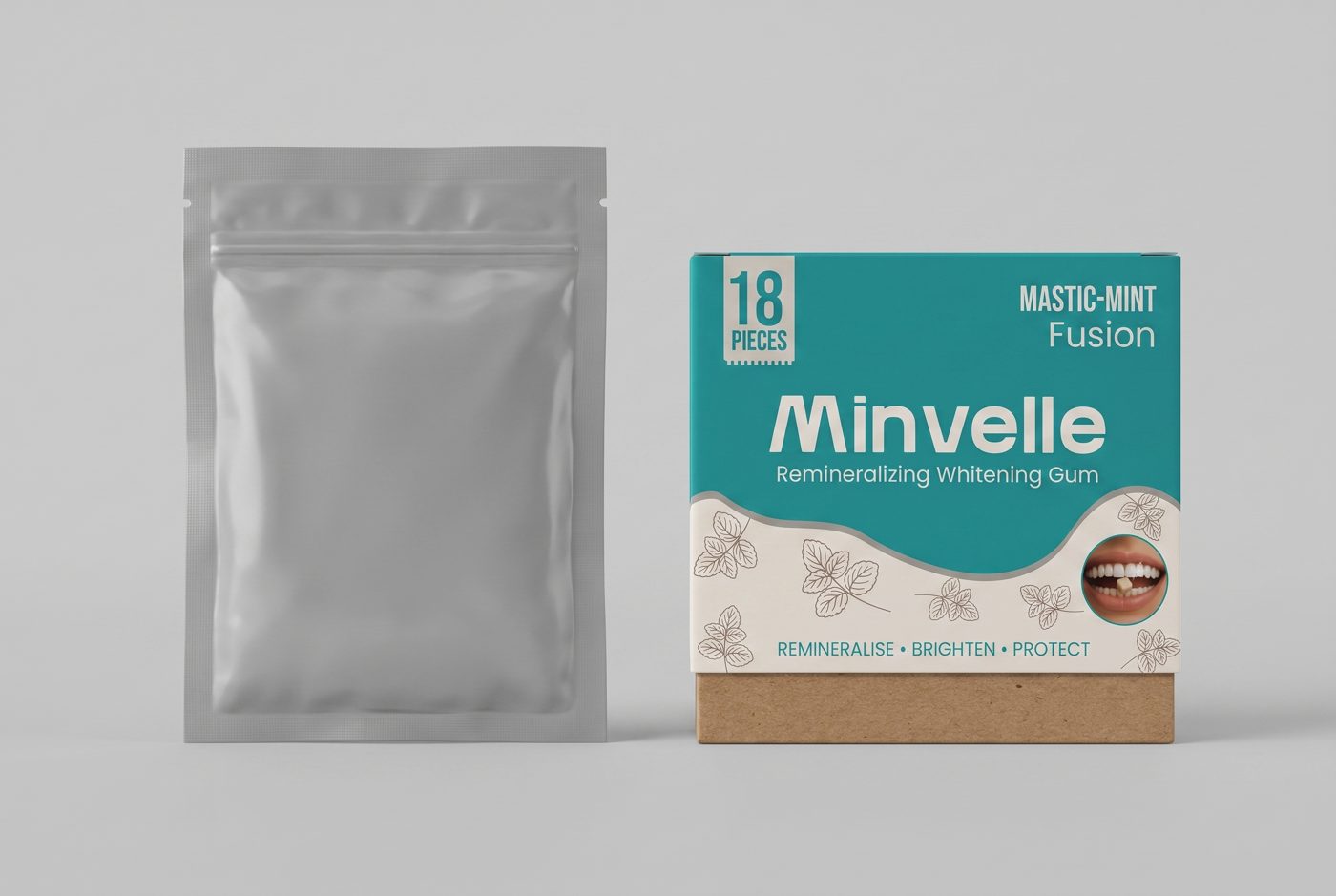
Here is an exercise that costs nothing and takes about ten seconds. Pick up any gum, mint or lozenge that promises something for your teeth, turn it over, and look for one specific line: how many milligrams of the active ingredient are in a single piece.
Take your time. On almost every box, it is simply not there.
You will find the marketing words on the front. You will find an ingredient list in descending order, which tells you an active ingredient exists but not how much of it you get. And on a lot of labels you will meet the category's favourite phrase: proprietary blend. Two words that quietly translate to: there is a number, and you are not getting it.
In most industries, hiding the dose would be disqualifying. In oral care it is Tuesday.
Why one missing number changes everything
With any functional ingredient, the dose is the line between an ingredient that is present and an ingredient that is doing something. A trace of hydroxyapatite is enough to print the word on the front of a box. A real, measured amount is what the research on remineralization is actually about.
So ask the obvious question. If a brand has a number it is proud of, why would it hide it? The only reason to leave the dose off the box is that the dose does not help your case. The opacity is not an accident of packaging. It is the strategy. A category that competes on shouting has every reason to keep the quiet number to itself.
Which means the missing line is not just annoying. It is the one piece of information that would let you tell a real product from an expensive placebo, and it is the exact piece they leave out.
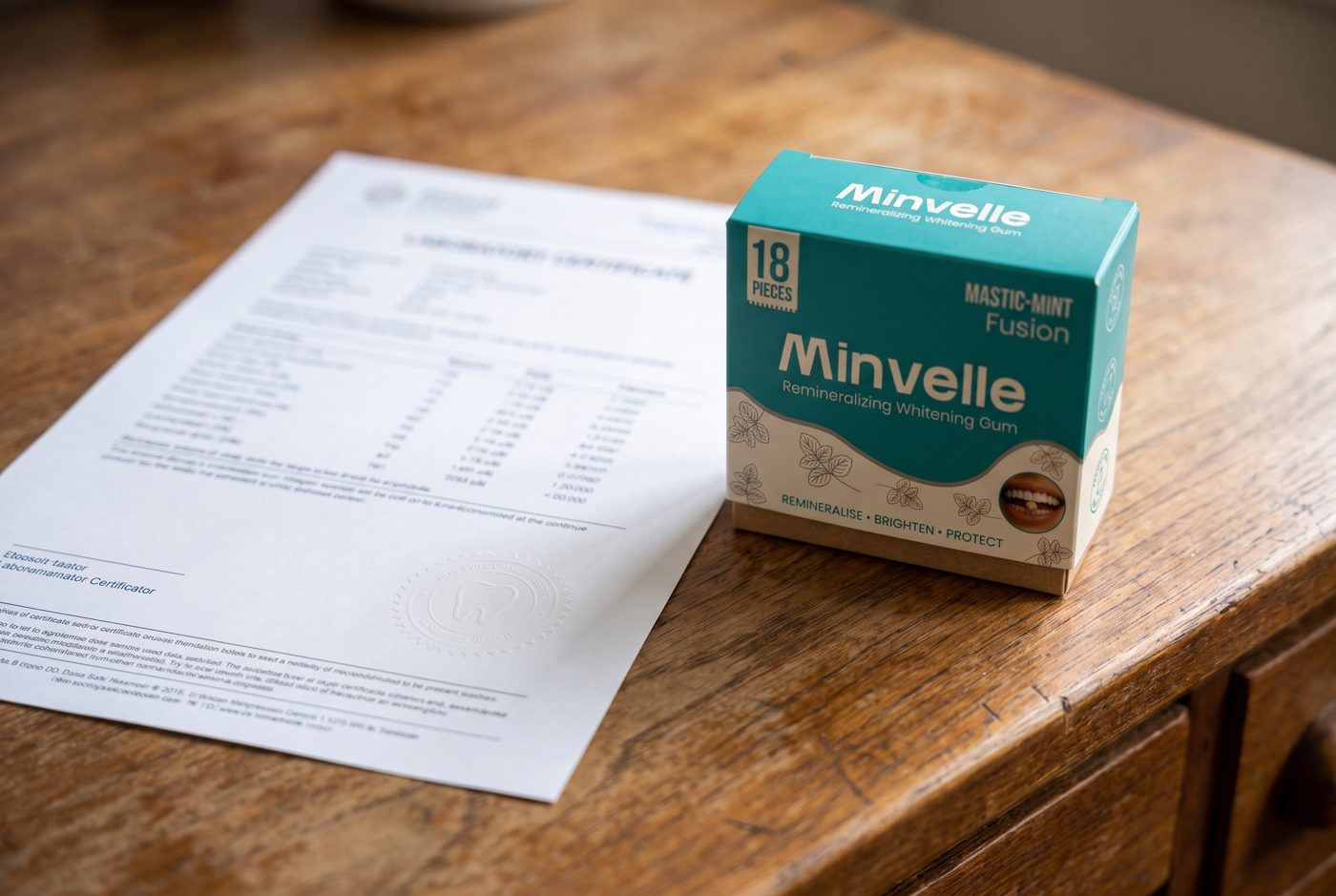
That is our number. It is published on our site, at a particle size of about 200 nanometers, next to a batch certificate we post publicly and a full list of all 14 ingredients. Not because we are saints. Because a category that hides its numbers is a category waiting for one brand that does not.
What the mineral actually does
This part is deliberately unexciting, which is how you know it is real. Your enamel is roughly 97 percent one mineral: hydroxyapatite. All day, your own saliva carries that same mineral back to the tooth surface, repairing the small wear that food and acid leave behind. It is a real maintenance system your mouth already runs, and it works best when it has material to work with.
That is the whole idea behind a remineralizing gum. Chewing gets saliva flowing within about twenty minutes. Nano-hydroxyapatite rides along with it, the same mineral your enamel is built from, sized small enough to sit where the surface needs it. In Japan, hydroxyapatite has been used in oral care since 1980, four decades of ingredient-level history the European aisle rarely mentions.
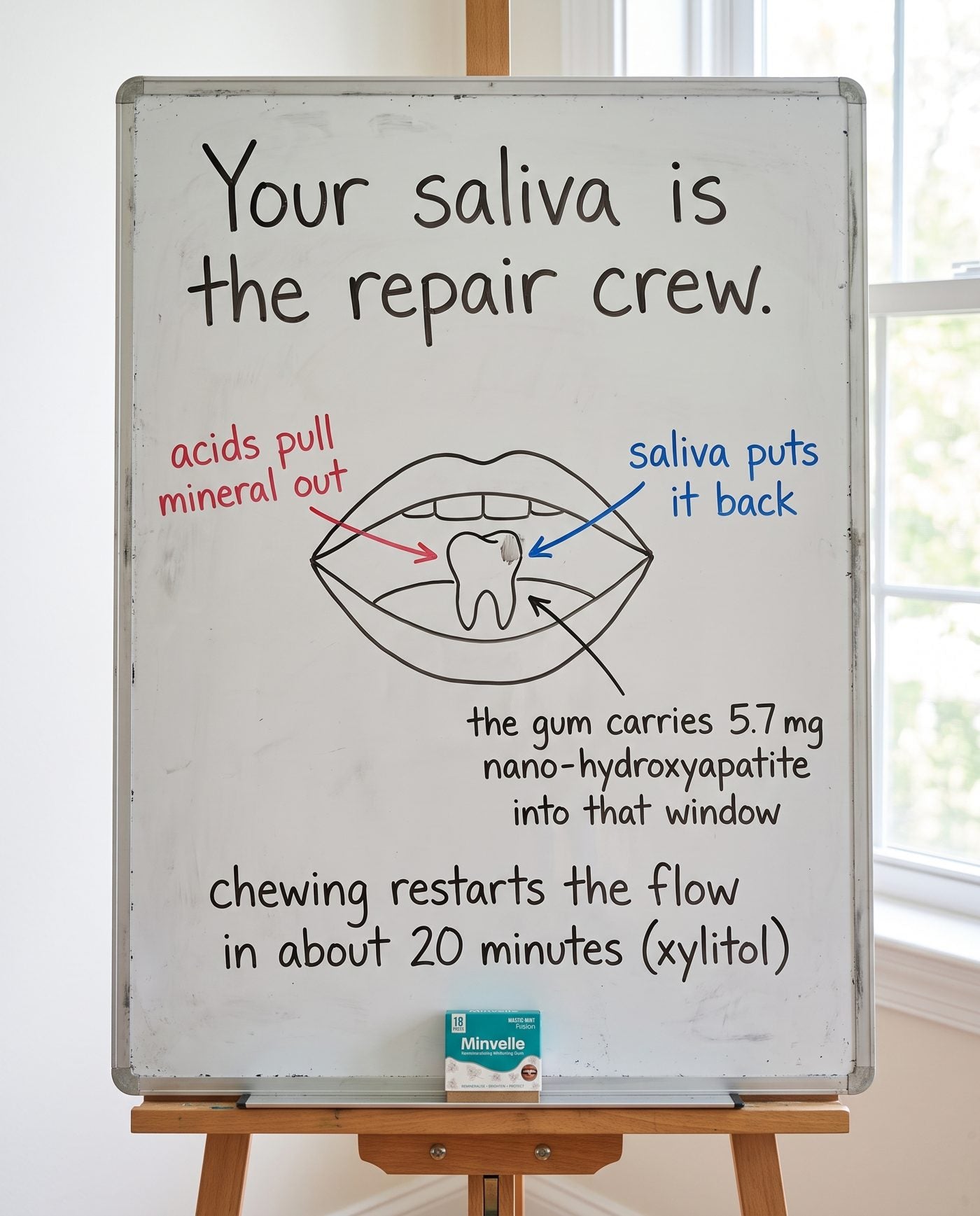
This is a gum, not a dental treatment. It does not replace brushing and it does not fix a cavity. It supports the enamel surface with the mineral it is built from. If a claim needs a study, we link the study. If there is no study, we do not make the claim.
Reading three labels side by side
The fastest way to see the category clearly is to line it up on the things that are actually checkable, not the things printed in the biggest font.
| Whitening strips | Generic whitening gum | Minvelle | |
|---|---|---|---|
| Active dose disclosed anywhere | No | Rarely | Yes, 5.7 mg |
| Public lab certificate | No | No | Yes |
| All ingredients listed | Partial | "Proprietary blend" | All 14 |
| How it works on the surface | Lifts a layer off | Often unclear | Adds mineral back |
| Common trade-off | Sensitivity, "zingers" | Unknown | Chew after coffee |
| Who stands behind it | No name | No name | Max, the founder |
See for yourself
The number, out in the open
Every claim on this page is posted on our public transparency page. Read it before you trust it.
What we actually publish
The parts a normal brand hides are the parts we put in front of you. The certificate is not a badge. It is a document you can open.
The questions a skeptic should ask
Does 5.7 mg actually do anything?
Is nano-hydroxyapatite safe?
Why should I trust a brand run by a 20-year-old?
Will it replace my toothbrush?
What if it is not for me?
Why a 20-year-old built this

Two years ago I was standing in an oral-care aisle reading labels, because that is the kind of person I am. Forty products promised me a transformation and not one told me the dose of anything. The more a box shouted, the less it disclosed. I remember thinking the whole category had decided I was not worth a straight answer.
So I built the answer. I am Max, I am 20, I run Minvelle from Austria, and I read the customer emails myself. There is no big team and no agency gloss. When you email us, the founder reads it, and the guarantee is the same plain deal as the label.
Max, founder
Picture the next eighteen days. One piece a day, after your coffee, and for once you know exactly what you put in your mouth and exactly how much of it. Not a promise on the front of a box. A number you checked.
Try it for 30 days
Buy the gum that tells you the dose
If it is not for you, the money-back guarantee covers unopened boxes. No trick, the same plain deal as the label, and I answer the email myself.
See the number we publishP.S. If you remember one thing from this, make it the exercise. Turn over the next whitening gum you see and look for the milligrams. When a label says trust me instead of a number, believe it. It is telling you something. Ours publishes the number: 5.7 mg per piece, on the front, with the certificate public.
Advertisement. This page is editorial content from Minvelle (MaxLife Trading GmbH), the maker of the product it describes. Every claim above is sourced on our transparency page, including the batch certificate, the full ingredient list, and references for the use of hydroxyapatite in oral care. Minvelle is a gum that supports enamel remineralization; it does not replace brushing and is not a treatment for dental disease.